On Reader Mail, Find Traps skill


A completely different Nick than yesterday writes: "Do you use a "Find Traps" skill for your thieves? Reading your materials, I can't really tell. I know you favor description and discovery through interaction, so if you use it, how do you have it "interface" with that? I'm struggling with this bit myself."

How does find traps interface with player skill-focused play?

This is a great question, and part of the answer has to do with infinite play and what you wish to spend your time doing; the other part has to do with the purpose of a trap.

What is the purpose of a trap?


The purpose of a trap is to make decisions meaningful. If there is no risk from just walking around, opening chests, or exploring rooms, then those activities become flat and dull. If the only threat is monsters, then you've removed uncertainty from the game, making it flatter and less interesting. Traps should make the play of the game more interesting.

How?
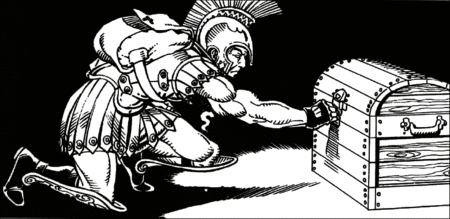
Traps should represent an unseen threat. Lurking in chests and doors, they are likely not visible. But in rooms and corridors, there should always be some sign of their placement. This sign should not always be obvious but should be visible to an alert party. I've written a whole lot about how to present this.

What do we wish to spend our time doing? 


The other question becomes what do we want to actually be doing at the table? Do you want players to describe in detail how they are approaching and interacting with chests? The fact is, with any simple object like a door or chest, the ways of approaching and dealing with it are limited. It is possible to create an itemized list of activities to do when approaching a door. Depending on the type of campaign and your players, this may or may not be an issue. It depends on what you want.

The secret you wish to know


So, do I use the find traps skill?

I've found that it is hard to remember to do things. My general approach, is that all room and corridor traps are openly visible, and players either handle them manually in the game or suffer the consequences, as my traps and agency series. Openly visible means that there is some descriptive clue given to their purpose. I hid wall scythe blades in jagged shadows. Bodies on the floor is an option for easy detection, a side effect of trap placement in the description is more difficult to discern from the detection. For doors and chests, if they ask, I will simply tell them if the door or chest is trapped.

They frequently don't ask.

It is apparently really really difficult to remember to do that. 

This works very well to put the focus squarely on player skill. I want to point out, that I only do this for searching for traps, not most activities, like packing, lighting torches, etc. Specifically, I don't assume players will hit in combat, a key pillar of play any more than I assume they are going to take the time to look for traps another key pillar of play. Standard D&D does not consider remembering to pack your sword as a pillar of play. There are games that do. Again, it depends on where you want to spend your time.

Most of the games I run don't even contain a search or find traps skill. The idea behind the original thief skills, was that they were semi-magical in nature. So in systems that do have a find traps skill, I run it as either a Danger Sense skill, or allow it to be rolled as an additional saving throw to avoid the effects of traps. The same with locks, in most campaigns - any normal lock can be opened by a thief. It is puzzle locks, complicated vault locks, and other special tricks that Open Locks is expected to address.

First published 1/7/14

On Reader Mail, The Comprehensive Search Bypassing Play


'J' writes in again with another question.

"One of my players wants to bypass the game-play by saying 'I search everything'. I've responded in the past by asking them to be more specific, but this isn't working well."

This sounds like a source of irritation to both the Dungeon Master, who doesn't want his work bypassed, and to the player who doesn't want to jump through hoops. This interaction can end up being very confrontational.

The solution is non-obvious. I never approach an interaction in a game by asking a player to do more. I maintain agency with this the same way I would with any action the player takes. I would describe the consequences of their choice and ask what they wish to do.

"I search everything."
"Ok, it will take you nine turns individually, or three turns as a group to thoroughly search "everything else". This will result in either three wandering monster checks if you search alone or one wandering monster check with a higher chance of a monster appearing due to the activity and noise if you search as a group. You may instead choose to specify what areas you are searching specifically to avoid having to do such an exhaustive search. What do you wish to do?" 
The consequences of actions are known, and the players can make an informed choice maintaining agency and receiving the expected result from their actions. As a byproduct, consequences for bypassing the Dungeon Master's carefully crafted rooms are maintained as well as the player not feeling as if they are having to jump through hoops.

'J' Replies:
"Using your example with the random encounters, if the player does say yes to the random encounters, do you just roll and then they discover the loose flagstone behind the throne even though they did not mention the throne at all, let alone behind the throne? 
"That bugs me for some reason. I feel your method would speed play, but at the cost of actual discovery. I feel it would be more rewarding for a player to discover the loose flagstone if they thought to look behind the throne."
The rules of the game indicate that there are two levels of hidden. "Concealed" and "Secret," so the answer to the question depends on what the hidden area is.

If it's concealed, then any verbal description of saying they are going to look at the area will discover it, as will any 'through search of the room' trading time for risk. If it's secret, then searching the area gives the 1 in 6 (or 2 in 6 for elves, or 3 in 6 for Dwarves (sliding stone) given in your example) chance to discover.

It is more rewarding for them to search for it themselves. The risk of having an encounter should be a fairly severe threat, so if they want to search every room they will not make it far.

I think also, that this particular mechanic is vastly improved if you note that the detection of a room trap or a secret door does not in any way grant information on how to disarm the trap or open the door.

Originally published 3/19/13

On Mace


 Sinless is just going great. Everyone is working, we've got people playing, the final parts are getting shored up; it's exciting.

Years ago, I noticed someone whose work reminded me of Halloway and the best of old-school D&D. Jeshields is an artist on Sinless. He lives in Alaska with his wife and more daughters than I can count (who are also artists), and he's recently decided to leave a graphic design job and illustrate full-time.

. . . 

You cannot imagine the coup this is for old-school gaming. Anyway, besides illustrating for Sinless and plenty of other old-school products, he's running a Kickstarter for MACE, a book of useable monsters. It's a much more concrete book and should work nicely with Bestial Encounters Caused by Monstrous Inhabitation.

Check it out here: MACE, monster and character encounters. 

I'm a backer at the highest level because it's the best work in the field. Already funded. Check it out before it's too late!


On the Final 48 hours

Sinless has just been amazing guys.


If you haven't checked it out, you should back now. Campaign ends Friday. 

It's around 700 people, which is enough for success you know? It's a big enough network. I couldn't be happier—and we aren't even done with the campaign!

Here's what you need to know.

  • Future support incoming. We are already working on a seminal adventure for Sinless.
  • SRD incoming. Open license planned. Looking to hire a VTT module designer.
  • Fast table play with cybernetic ninjas, sorcery, and uplifted pug detectives. 
  • Integrated domain game.
  • All items, gear, vehicles, assets, illustrated.
  • A4 Hardcover
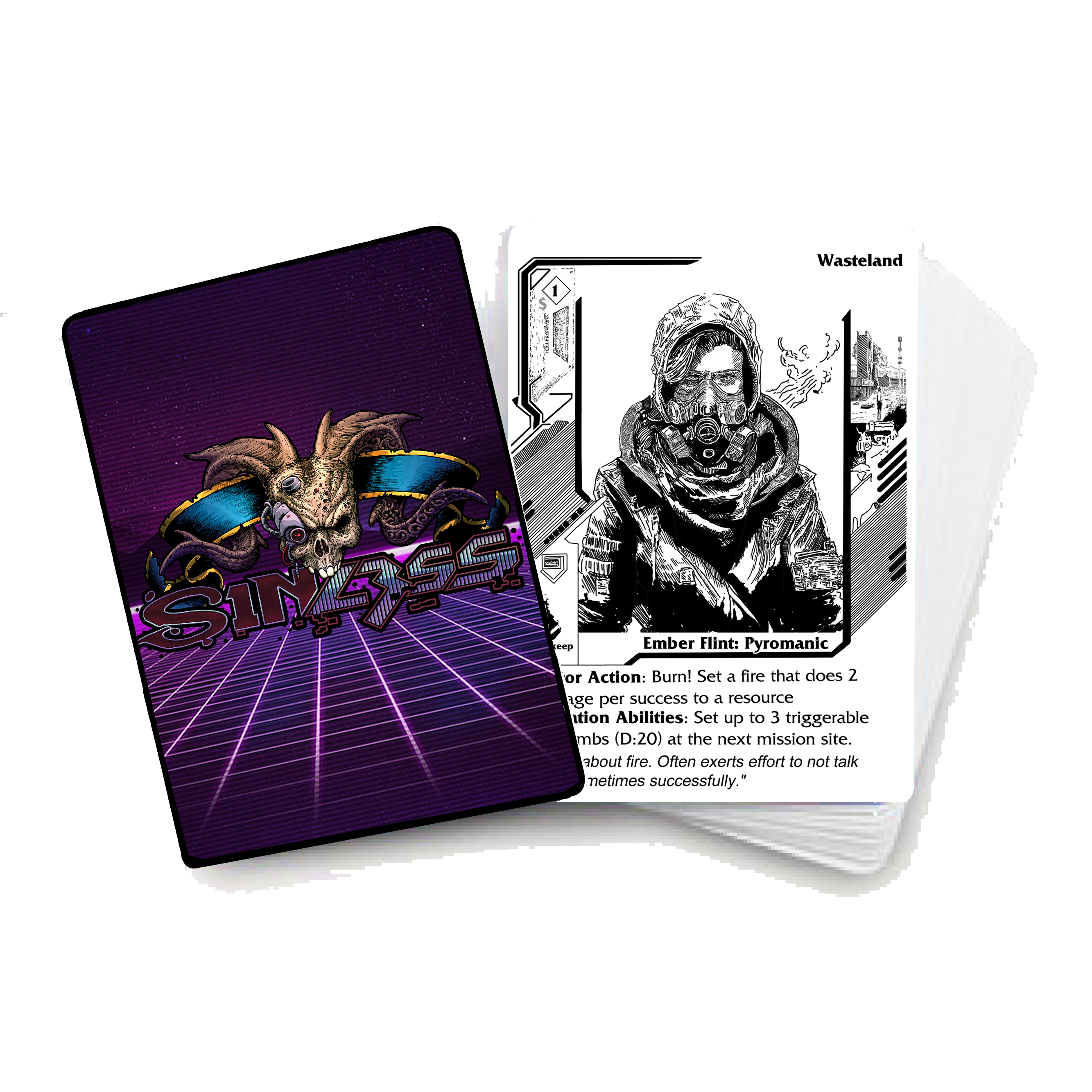
  • Bonus decks of cards for assets and chases
It's just a good deal! Get in and get exclusive Kickstarter content. 

If you want more information, I've got a ton of interviews, in text, audio, and video!

If you've already backed, now is the time to annoy people on social media with it.

This is and has been amazing and thank you for making something awesome like this possible. 
-Campbell


Talking Crit (Video)

Mildra the Monk (Audio)


On Sinless Combat!

 Sinless combat is so cool!

I remember, once, during a game of 4e Dungeons and Dragons, I had enough time between rounds to calculate every one's average basic attack damage (since all our encounter/utility cards were burned) and determine with statistical accuracy that we had 14 more rounds to go until we killed the boss. Sure enough, 14 rounds later, he was dead. 

Can we conceptualize how many failures in that experience there are? 

Sinless is not like that. Sinless combat is violent and terrifying. 

The truth is, the weapons we have today, even toned down for a tabletop role-playing game, are ridiculous. A Vulcan Cannon fires 7200 rounds per minute. That's 120 bullets per second.  The main limiting factor in its use is that the ammo weighs so much it can only fire for a few minutes. They were worried about the bullets hitting the ground, so they program them to explode in 4 seconds after a mile. 

Full auto is a thing. It is very hard to survive if you are caught in the open, and someone shoots 30 bullets at you. Sinless is not a game about slowly removing opponents' hit points while they retain their full effectiveness. In an extended conflict, the Sinless are sure to lose. 

Which is why they don't do that. 

They prepare ahead of time and know the location and general power of the opposition. They develop a plan to obviate challenges like Vulcan cannons, accomplish their objective and plan an escape. And five out of six times, things go as planned. 

That other time though, they miss something in the dossier, and there's an unexpected threat they didn't prepare for. Do you decide as a referee when this happens? My advice would be no. There are always more threats on a site than it's possible for players to prepare for. Sometimes they don't check for magical critters, and there aren't any magical critters there. That one time, they miss that and have a hydra pop up to cock their run.

I use operations to introduce characters, conflicts, and background information and later use that information to design future runs and create a changing campaign world. I'm designing a run generator and referee tools that allow you to do this with low overhead. 

And after every operation, there's always fallout. Maybe someone got snapped by a camera. Maybe someone is seeking revenge. 

Combat is about solving problems that you've prepared for. And the design of missions leaves plenty of room for surprises. What about people that are organized and plan well? Well, maybe they are ready to move up to the professional tier of missions. Like all classic play styles, players can choose their level of danger. 

It can be a shift from people who are used to encounters designed to be fought and won. A well-run and planned operation isn't one that exposes the players to return fire. That said, characters in Sinless are quite competent and powerful, which means they have the ability to address "surprises" in the run.  There's very much a fun dynamic in my playtests where the players are like:

It's a great time. :-)

If this sounds like something that you might like to have at your table, be sure to back the Kickstarter now to avoid missing out on exclusive Kickstarter content!


Hack & Slash 

Follow, Twitch, Newsletter, Support, Donate to end Cancer (5 Star Rating)

On a Sinless update and the gameplay loop.


Honestly, I'm so chuffed.

I isolated and read a lot as a child, and when I imagined the future as someone who made these rpg books it seemed like a fantasy. It's amazing every day I wake up. And it's because of you, so thanks! I am grateful daily.

What's really cool though, is the Sinless gameplay loop.

Focus on the Gameplay Loop

In the tactical mercenary team game, there are two phases. The tactical mission, and the base/character building.  You get new toys, you go on the next mission to play with the toys, and you get more toys.

But in an role-playing game?

It's not limited like those spaces. It's not the Argo or the Avenger.  How to increase the scope without chaos?

Enter sectors and resources. Each sector is a conceptual downtown space, laid over a map like a point-crawl, rather than a consistent physical measure of distance. And each space has a variety of resources which are things like "apartments", "casinos", "power stations", "media outlets," et. al. The full list is in the rules document available to backers.

These resources are general categories (e.g. factories) that turned into specific resources in a sector. (e.g. Westfork Chemical Processing). Players can take over resources from their owners using sector actions. Players can blow up and demolish resources from their owners. Players can build new resources in empty spots.

But it's even better than that.

One of the sector actions available is "Do Crime". And while crime generates revenue, it also raises heat. In my Monday session, players raised the heat in their sector to 2 by doing crime, which gives a bonus to the amount of money all vice resources produce, meaning the bar they own made more money! (conversely, having no heat is a boon to business resources.)

You can do enough crime in a sector to cause a crackdown. This causes a heavy enforcement presence and shuts down all resources in the sector. This is also a way to solve problems.

The actions in the sector turn affect the operational turns (the uh, tactical crime operation). The actions during the operational turn affect the sector turns. This is explicit mechanically. e.g.

"After the session, the players and Agonarch agree on a level of destruction (none, some, lots, total) and a level of influence exerted on a resource (none, minor, major, exceptional). Some destruction does 1d3 damage, lots of destruction does 1d6, and total destruction does 2d6 damage to the resource condition track. Minor influence grants 1 point, major grants 2, and exceptional grants 3. Heat is raised by 1 for minor changes, 2 for major ones, and 3 for exceptional/total changes."

So at the end of every job, they get paid, and can use sector turns to raise more money, buy rare gear, purchase additional assets, build up their resources and take over new resources. Then they get a new job which is an opportunity to use all their new tools! Both assets and resources can provide bonuses during operations. One asset might allow you to plant bombs or guns in the operation site, others might affect all the guards or shut down digital defenses.

So it's this nice loop during play. They finish a mission, get money and kismet to level up. They level up, and turn to the sector turn to invest/spend their money. They get a lot of new stuff (assets, gear, abilities) and progress during the sector turn. Then leveled up they look for a new job.


Related Posts Plugin for WordPress, Blogger...