Showing posts with label tricks and traps. Show all posts

On Reader Mail, Find Traps skill


A completely different Nick than yesterday writes: "Do you use a "Find Traps" skill for your thieves? Reading your materials, I can't really tell. I know you favor description and discovery through interaction, so if you use it, how do you have it "interface" with that? I'm struggling with this bit myself."

How does find traps interface with player skill-focused play?

This is a great question, and part of the answer has to do with infinite play and what you wish to spend your time doing; the other part has to do with the purpose of a trap.

What is the purpose of a trap?


The purpose of a trap is to make decisions meaningful. If there is no risk from just walking around, opening chests, or exploring rooms, then those activities become flat and dull. If the only threat is monsters, then you've removed uncertainty from the game, making it flatter and less interesting. Traps should make the play of the game more interesting.

How?
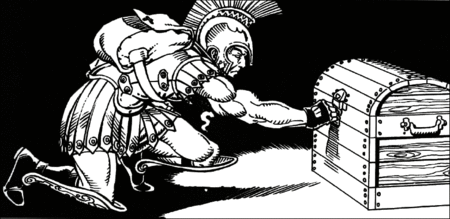
Traps should represent an unseen threat. Lurking in chests and doors, they are likely not visible. But in rooms and corridors, there should always be some sign of their placement. This sign should not always be obvious but should be visible to an alert party. I've written a whole lot about how to present this.

What do we wish to spend our time doing? 


The other question becomes what do we want to actually be doing at the table? Do you want players to describe in detail how they are approaching and interacting with chests? The fact is, with any simple object like a door or chest, the ways of approaching and dealing with it are limited. It is possible to create an itemized list of activities to do when approaching a door. Depending on the type of campaign and your players, this may or may not be an issue. It depends on what you want.

The secret you wish to know


So, do I use the find traps skill?

I've found that it is hard to remember to do things. My general approach, is that all room and corridor traps are openly visible, and players either handle them manually in the game or suffer the consequences, as my traps and agency series. Openly visible means that there is some descriptive clue given to their purpose. I hid wall scythe blades in jagged shadows. Bodies on the floor is an option for easy detection, a side effect of trap placement in the description is more difficult to discern from the detection. For doors and chests, if they ask, I will simply tell them if the door or chest is trapped.

They frequently don't ask.

It is apparently really really difficult to remember to do that. 

This works very well to put the focus squarely on player skill. I want to point out, that I only do this for searching for traps, not most activities, like packing, lighting torches, etc. Specifically, I don't assume players will hit in combat, a key pillar of play any more than I assume they are going to take the time to look for traps another key pillar of play. Standard D&D does not consider remembering to pack your sword as a pillar of play. There are games that do. Again, it depends on where you want to spend your time.

Most of the games I run don't even contain a search or find traps skill. The idea behind the original thief skills, was that they were semi-magical in nature. So in systems that do have a find traps skill, I run it as either a Danger Sense skill, or allow it to be rolled as an additional saving throw to avoid the effects of traps. The same with locks, in most campaigns - any normal lock can be opened by a thief. It is puzzle locks, complicated vault locks, and other special tricks that Open Locks is expected to address.

First published 1/7/14

On The Why of Red Herring Agency


All of these traps are predicated on the idea of Agency.

What's that mean, functionally in play?

When players have their characters walk into the room, they get a description of all relevant manipulable widgets. This way if they miss something, it is due to player choice/skill and not due to a die roll.

This is a very engaging way of playing. Sometimes the experience is so horrible that people will think that other people should not be allowed to play this way! Why is that? Because if this is done poorly it isn't fair. After all, you just killed your players with no warning! Who would want to play in that game?

Not me.

Here is the problem I ran into when I started. I would describe the room, with all its relevant features. Then my players would avoid the rooms with burn marks, stains, pulverized dust - or only approach them in hazmat suits; and immediately start manipulating every object listed in the room. I didn't want to be unfair. I didn't want to leave anything out. Therefore, at first, everything was simple.

What was the solution? Complex mechanisms and Red Herrings.

When an encounter is designed, you need to leave some clues for traps and such. Do these clues need to be obvious? No. Do these mechanisms need to be simple? No. Does everything you put in the room have to be relevant? No.

Remember, their interactions in the room take time. During this time you're rolling encounter checks. This is the cost of being thorough. Make sure that some of your encounters can threaten your players, so this is an actual cost.

Some actual rules clarifications are useful. I allow people, when unsure of the environment to perform a thorough search. One person can search a 10' x 10' surface section per turn. When they search they get standard chances to detect secret doors. Knowing that the door exists does not automatically mean they know how to open it. I do not inform them of the results of the rolls. This turns the decision into an interesting choice.

Read Part II here. . .

originally published 6/2012

On The What of Red Herring Agency


Last weeks article is here.

How to avoid being obvious. There are three watchwords here.

Be Subtle

Be Complicated

Be Crafty

Of course this requires planning your room descriptions out ahead of time. My model for this is the 1st Edition DMG.

"DM:'The sacks hold rotten grain, so the cleric will go and help the magic-user as ordered. They find the refuse consists of castings, some husks of small victims of the spider, hide, bones, a small humanoid skull, and 19 silver pieces. Do you now fire the webs overhead?'
LC: 'Examine the skull first. What kind of humanoid was it? Can we tell?'
DM: 'Possibly a goblin. When you are looking at it more closely, you see that there is a small gem inside - a garnet.'"

And

DM:'First, the others checking the containers find that they held nothing but water, or ore totally empty, and that the wood is rotten to boot. You see a few white, eyeless fish and various stone formations in a pool of water about 4' to 6' deep and about 10' long. That's all. Do you wish to leave the place now?"
LC:'Yes, let's get out of here and go someplace where we can find something interesting.'
OC: 'Wait! If those fish are iust blind cave types, ignore them, but what about the stone formations? Are any of them notable? If SO, I think we should check them out.'

DM:'Okay. The fish are fish, but there is one group of minerals in the deepest part of the pool which appears to resemble a skeleton, but it simply - '

Be Subtle:  This means downplay the things you mention. Mention them as if they are unimportant items in the room. There's a yellow cloak, some leather boots and a sword. Is the cloak covered in yellow mold? Do the boots hold a key? Is the sword rusted or magical? If you just described 10 other things in the room will the important thing stand out?

It shouldn't.

Walls aren't soot covered or covered in blood. Walls are stained, dirty, dark, filthy. The floor isn't covered in pulverized rock, the ground is sandy, dirty, or dusty.

Be Complicated: The way into the secret room, isn't always in this room. Secret doors are not always two way. Your hints, maps, treasure maps and clues can be abstract. Mechanisms can be specific (You must lift up on the east side of the slab, the spider decoration on the iron chair in the corner must be lifted, the right eye of the frog mosaic must be pressed in 3 times.) For the uninitiated, here is Why This Is Not Pixel Bitching.

Be Crafty: This is, know what your players are expecting. Did you trick them with yellow mold once? So they are expecting gold or yellow things to be dangerous? Put a gold or yellow thing on a wall that when poked, triggers a trap. When the poke it with a stick, to test if it's yellow mold, they get hit with the trap! Don't design your encounters in a vacuum. Have a repeating feature in your dungeon, like round stones in the wall. Have one of the stones depress to deactivate a trap, and another that presses in to activate a trap. Then leave a map as a clue, but make the map vague and abstract. Engage your players, make them think!

Originally published 6/2012

On the Thursday Trick, Doors & Chests

Doors & Chests 
I talk a lot about agency in traps, about having signs of the traps be obvious but subtle, about distracting from what the real clues are and about how to make them interesting.

All this gets tossed out the window for doors and chests. Why?  Because they are common and commonly trapped. In most cases the trapping mechanism is subtle and hard to detect. And the procedure for checking them using player skill would rapidly reach the point where it was comprehensive and going through that process would be boring and repetitive.

It is an actual example where character skill trumps player skill. I can explain how to crack a safe or pick a lock, but it is practice and exposure to different safes and locks that really determines your ability.

So, for traditional, classic, door and chest traps, I don't bother describing the mechanism of the trap. 
This is reliant upon the relevant thief skill.  It is the thief's equivalent to fighting or casting spells. I do certainly think it is reasonable to create a unique game or subsystem for opening locks or detecting traps (Such as pulling Jenga blocks, winning hands of war, etc.)

Detection/Disarming: Here are some lists of common door and chest traps!

  • Poison
    • Contact poison on treasure
    • Contact poison on container
    • Poison needle in lock or handle
    • Poison darts in front, top, inside lid, or bottom.
    • Poison Gas (in chest, in door handle)
  • Scything blade, cutting, up, down, etc.
  • Contains deadly vermin
  • Triggers another nearby trap, trap door, crushing stone block, etc. (Note that this trap can have plenty of agency)
  • Triggers a Magic Spell
  • Mimic
  • Acid spray
  • Explosive
How to deal with overactive door kickers?
  • Dropping blades
  • Weighted line that releases a metal spear shaft from the ceiling behind the kicker
  • Weakened doors that break eaisly to allow blades to amputate the limbs
  • Snares in the door
  • Spring loaded blades in doors
  • Shooting blades that fling out
  • Portcullises that drop when the door is opened (to prevent the peek and flee)
  • Spiked clamps triggered around the surrounding ceiling, floor, or walls
  • Door contains deadly substance
  • Doors that spring out, slamming targets into the walls, floor or ceiling
  • Things perched on the tops of doors
  • Doors covered in sticky, toxic, or dangerous substances


If you like posts like this, support me on Patreon!

On 10 Ways To Open A Chest

"But assuming it was a treasure hunting expedition (and the lower floors of the tower were reasonably cleared, with a path of escape blocked only by wandering monster rolls) what would a party need to do in one of your games to safely open a chest?"

Here are 10 ways to open a chest safely!

10. Pour acid in the lock.
9. Use a pick and chisel to break apart the lock mechanism.
8. Use a crowbar and specialized tools to pry the lock out of the chest.
7. Saws!
6. Carry the chest back to town and pay the thieves guild to open it.
5. Hammers!
4. Knock!
3. Unscrew the lid hinges.
2. Pry off the back of the lid!

And the number one way to open a chest safely?

1. Have the thief open it, there's always more where they came from!

Why don't they just do these things by default? They are time consuming, loud, or require heavy encumbrance penalties.

On the Thursday Trick, Vents, Sprays, and Agency

This post was originally published in September of 2011. If you're interested in Tricks and Traps like these, be sure to check out Artifices, Deceptions, and Dilemmas, collecting all of these along with beautiful illustrations. 

Vents & Sprays (Vents/Sprays)

Trigger: Varies Effects: Multiple Targets, Never Misses
Save:WandsDuration: Instant
Resets: AutomaticBypass: Avoid

Description: These traps are characterized by a variety of factors that separate them from spells or ranged attack traps. First, they often involved gasses or liquids and because they are often sprayed out over a large area they have the property of never missing.

In some cases there is also an onset delay. This means these traps can be triggered and the effect happen in a certain amount of time (sprinklers in a room) or a delay before the substance affects the characters (such as a room filling with water.

Examples of the things that might be vented or sprayed included slime, shrapnel, cold, acid, boiling water, flaming oil/tar, sewage, mummy dust, poison, fire, magma, smoke, methane, sand, steam, sulphur, and water.

If a to hit roll is required it will always ignore armor, but not necessarily shield bonuses. Saving throws may apply given the circumstance. Rods, Staves and Wands is the traditional saving throw for such attacks, allowing half damage or to avoid instant death.

Detection: These traps can be both the best kinds of traps, and the worst kinds of traps. Because they often have extremely negative properties, they can be ran in such a way where they are just Gotcha! traps, causing death or massive damage very quickly. However, this is an extremely poor way to run such traps, for several reasons. None of the vents and sprays above will be able to remove signs of their presence. Some examples
  • Slime will leave a slick slimy coating on the walls and floor
  • Shrapnel will leave gouges and scars in the walls and floor and ceilings
  • Cold vents and sprays may show some signs of their presence due to temperature differences,  areas where the cold strikes repeated may show cracking, the growth of natural molds and fungi may be retarded. If the trap is triggered often or recently, there may be frost, ice or water on surfaces. If it has been triggered somewhat recently, the water will affect the appearance of the walls (they will be cleaner).
  • Acid will leave pits and scarring on whatever surface it is sprayed on. There may be a scent, or the players eyes may start to become irritated.
  • Boiling water may show up due to temperature differences, and will generally insure a sparkling clean area where the walls and floor are blasted with it.
  • Flaming oil and tar will generally cover the upper walls and ceiling with black soot, and the floor may appear greasy or covered in scorch marks. Tar will stick to a surface and blacken and harden under high heat. The hallway may carry a scent of burning tar.
  • Sewage will smell overpoweringly terrible, unless it is stored behind water (like in a toilet) or behind an air tight valve or door.  There will still be an odor because it will be triggered occasionally filling an area with filth. There may be an unusually high amount of mold or spores or other type things in the area due to the rich food source the filth provides.
  • Mummy Dust may leave a coating of dust on surfaces, cause a musty spell, and their may be corpses in the hallway.
  • If a poison is being used in a spray, it most likely is fairly virulent, and therefore their should be corpses, either dessicated in a forgotten dungeon like a tomb, or bones or signs of being dragged off in a more active area.
  • If fire is being vented out, then on the surface that the fire is across from there will certainly be burn or scorch marks. Their may also be burnt corpses.
  • Magma if sprayed or vented out, will melt and re-solidify, causing whatever surface the magma contacts to deform. Areas where magma is sprayed will bubble, twist, buckle, and bulge from the constant melting and re-hardening. Bones and various other mineral items (armor and such) may be embedded in seeming solid surfaces.
  • Smoke will often linger for far longer then it takes to dissipate, leaving a smell for 60' to 100' from the location of the trap for days.
  • Methane is a very dangerous trap, relying on the players flaming light to trigger an explosion. There are several things to keep in mind with methane. First, it is odorless, the natural gas smell you are familiar with is a modern additive to help detect leaks. Second, it displaces oxygen, so even if the entire party has some means of seeing in the dark, it can rapidly cause asphyxiation. Use the rules for how long characters can hold their breaths unprepared for the length of time they can stay conscious.
  • Sand will both collect on the floor (and in clothes, armor, food, despite the best intentions). The first notice the adventurers will have will likely be the sound of sand crunching under their feet. Any surfaces subject to a spray of sand will likely be scrubbed clean. Repeated sand blastings will scour a surface clean, but will also remove the top layer, exposing rougher rock or metal beneath. Sometimes this will be used to fill a sealed chamber, in which case sand coated corpses will often be discovered.
  • Steam is going to insure that whatever surfaces the steam hits are clean, except for the bits of boiled flesh that it removes from it's targets. Do not forget to continue to apply damage as heat metal for people caught in steam wearing metal armor.
  • Sulfur is an interesting compound, either acidic causing burns, or a fine dust causing explosions, or a gas, causing choking and irritation. It is also known as brimstone. The primary method of detection is it's overpowering rotten eggs smell, which is natural.
  • Water is often not sprayed on people for damage, but more often is used to fill a sealed chamber trapping and drowning whoever is within. Water traps often leave water marks, as the fluid removes dirt and grime from surfaces and deposits it on a line along the wall. It also can have a briny or salty smell.
Do not forget that the vents and sprays also must come from somewhere. Nozzles, slots, slats or shutters will be visible places where the substances are expelled.

If you like posts like this, support me on Patreon!

On The Thursday Trick: The Kissing Maiden

This post was originally published in December of 2011. If you're interested in Tricks and Traps like these, be sure to check out Artifices, Deceptions, and Dilemmas, collecting all of these along with beautiful illustrations. 

In honor of the only trap in Skyrim to cause me to die. Twice.

Swinging Grate (Melee Attack)
Trigger: Pressure PlateEffects: None
Save: WandsDuration: Instant
Resets: AutomaticBypass: None (Avoid)
Disarm

Description: Often triggered by a pressure plate that releases tension, this trap swings forward impaling anyone standing in its way. This can be a single sharp post (al' la the original Conan movie), an entire wall, or even a statue of a beautiful woman. The trap often comes equipped with a counterweight for automatic rearming.

Detection: In the vast majority of cases this trap must be visible. It can be camouflaged or concealed, but the impaling mechanism can be seen. Common means of camouflaging the trap include vegetation growing on the mechanism, dim light, and angled walls and corners.

There are often blood spots on the floor and end point of the traps arc of execution. Even if successful, there will rarely be a body, due to its tendency to become impaled on the trap itself. If struck by a trap with a body already in it, damage might be mitigated. Bodies or skeletons hanging without supports on the wall might be another way to detect this trap.

More subtle means of detection include the hollow space where the counterweight resides. This will often be in either a wall or floor. The trap can be disarmed, but this almost universally results in the trap being triggered because it is under tension. Having a firm grip on the trap and releasing the tension slowly is one option, another is to not be where the trap is triggered.

If you like posts like this, support me on Patreon!

Related Posts Plugin for WordPress, Blogger...