Showing posts with label series (tricks/traps). Show all posts

On The Why of Red Herring Agency


All of these traps are predicated on the idea of Agency.

What's that mean, functionally in play?

When players have their characters walk into the room, they get a description of all relevant manipulable widgets. This way if they miss something, it is due to player choice/skill and not due to a die roll.

This is a very engaging way of playing. Sometimes the experience is so horrible that people will think that other people should not be allowed to play this way! Why is that? Because if this is done poorly it isn't fair. After all, you just killed your players with no warning! Who would want to play in that game?

Not me.

Here is the problem I ran into when I started. I would describe the room, with all its relevant features. Then my players would avoid the rooms with burn marks, stains, pulverized dust - or only approach them in hazmat suits; and immediately start manipulating every object listed in the room. I didn't want to be unfair. I didn't want to leave anything out. Therefore, at first, everything was simple.

What was the solution? Complex mechanisms and Red Herrings.

When an encounter is designed, you need to leave some clues for traps and such. Do these clues need to be obvious? No. Do these mechanisms need to be simple? No. Does everything you put in the room have to be relevant? No.

Remember, their interactions in the room take time. During this time you're rolling encounter checks. This is the cost of being thorough. Make sure that some of your encounters can threaten your players, so this is an actual cost.

Some actual rules clarifications are useful. I allow people, when unsure of the environment to perform a thorough search. One person can search a 10' x 10' surface section per turn. When they search they get standard chances to detect secret doors. Knowing that the door exists does not automatically mean they know how to open it. I do not inform them of the results of the rolls. This turns the decision into an interesting choice.

Read Part II here. . .

originally published 6/2012

On The What of Red Herring Agency


Last weeks article is here.

How to avoid being obvious. There are three watchwords here.

Be Subtle

Be Complicated

Be Crafty

Of course this requires planning your room descriptions out ahead of time. My model for this is the 1st Edition DMG.

"DM:'The sacks hold rotten grain, so the cleric will go and help the magic-user as ordered. They find the refuse consists of castings, some husks of small victims of the spider, hide, bones, a small humanoid skull, and 19 silver pieces. Do you now fire the webs overhead?'
LC: 'Examine the skull first. What kind of humanoid was it? Can we tell?'
DM: 'Possibly a goblin. When you are looking at it more closely, you see that there is a small gem inside - a garnet.'"

And

DM:'First, the others checking the containers find that they held nothing but water, or ore totally empty, and that the wood is rotten to boot. You see a few white, eyeless fish and various stone formations in a pool of water about 4' to 6' deep and about 10' long. That's all. Do you wish to leave the place now?"
LC:'Yes, let's get out of here and go someplace where we can find something interesting.'
OC: 'Wait! If those fish are iust blind cave types, ignore them, but what about the stone formations? Are any of them notable? If SO, I think we should check them out.'

DM:'Okay. The fish are fish, but there is one group of minerals in the deepest part of the pool which appears to resemble a skeleton, but it simply - '

Be Subtle:  This means downplay the things you mention. Mention them as if they are unimportant items in the room. There's a yellow cloak, some leather boots and a sword. Is the cloak covered in yellow mold? Do the boots hold a key? Is the sword rusted or magical? If you just described 10 other things in the room will the important thing stand out?

It shouldn't.

Walls aren't soot covered or covered in blood. Walls are stained, dirty, dark, filthy. The floor isn't covered in pulverized rock, the ground is sandy, dirty, or dusty.

Be Complicated: The way into the secret room, isn't always in this room. Secret doors are not always two way. Your hints, maps, treasure maps and clues can be abstract. Mechanisms can be specific (You must lift up on the east side of the slab, the spider decoration on the iron chair in the corner must be lifted, the right eye of the frog mosaic must be pressed in 3 times.) For the uninitiated, here is Why This Is Not Pixel Bitching.

Be Crafty: This is, know what your players are expecting. Did you trick them with yellow mold once? So they are expecting gold or yellow things to be dangerous? Put a gold or yellow thing on a wall that when poked, triggers a trap. When the poke it with a stick, to test if it's yellow mold, they get hit with the trap! Don't design your encounters in a vacuum. Have a repeating feature in your dungeon, like round stones in the wall. Have one of the stones depress to deactivate a trap, and another that presses in to activate a trap. Then leave a map as a clue, but make the map vague and abstract. Engage your players, make them think!

Originally published 6/2012

On the Thursday Trick, Doors & Chests

Doors & Chests 
I talk a lot about agency in traps, about having signs of the traps be obvious but subtle, about distracting from what the real clues are and about how to make them interesting.

All this gets tossed out the window for doors and chests. Why?  Because they are common and commonly trapped. In most cases the trapping mechanism is subtle and hard to detect. And the procedure for checking them using player skill would rapidly reach the point where it was comprehensive and going through that process would be boring and repetitive.

It is an actual example where character skill trumps player skill. I can explain how to crack a safe or pick a lock, but it is practice and exposure to different safes and locks that really determines your ability.

So, for traditional, classic, door and chest traps, I don't bother describing the mechanism of the trap. 
This is reliant upon the relevant thief skill.  It is the thief's equivalent to fighting or casting spells. I do certainly think it is reasonable to create a unique game or subsystem for opening locks or detecting traps (Such as pulling Jenga blocks, winning hands of war, etc.)

Detection/Disarming: Here are some lists of common door and chest traps!

  • Poison
    • Contact poison on treasure
    • Contact poison on container
    • Poison needle in lock or handle
    • Poison darts in front, top, inside lid, or bottom.
    • Poison Gas (in chest, in door handle)
  • Scything blade, cutting, up, down, etc.
  • Contains deadly vermin
  • Triggers another nearby trap, trap door, crushing stone block, etc. (Note that this trap can have plenty of agency)
  • Triggers a Magic Spell
  • Mimic
  • Acid spray
  • Explosive
How to deal with overactive door kickers?
  • Dropping blades
  • Weighted line that releases a metal spear shaft from the ceiling behind the kicker
  • Weakened doors that break eaisly to allow blades to amputate the limbs
  • Snares in the door
  • Spring loaded blades in doors
  • Shooting blades that fling out
  • Portcullises that drop when the door is opened (to prevent the peek and flee)
  • Spiked clamps triggered around the surrounding ceiling, floor, or walls
  • Door contains deadly substance
  • Doors that spring out, slamming targets into the walls, floor or ceiling
  • Things perched on the tops of doors
  • Doors covered in sticky, toxic, or dangerous substances


If you like posts like this, support me on Patreon!

On the Thursday Trick, Props: Codes and Hidden Messages Part I

If you're interested in Tricks and Traps like these, be sure to check out Artifices, Deceptions, and Dilemmas, collecting all of these along with beautiful illustrations. 

Props are physical puzzles, tricks, and brain-teasers you can hand to your players at the table for them to actually physically handle.

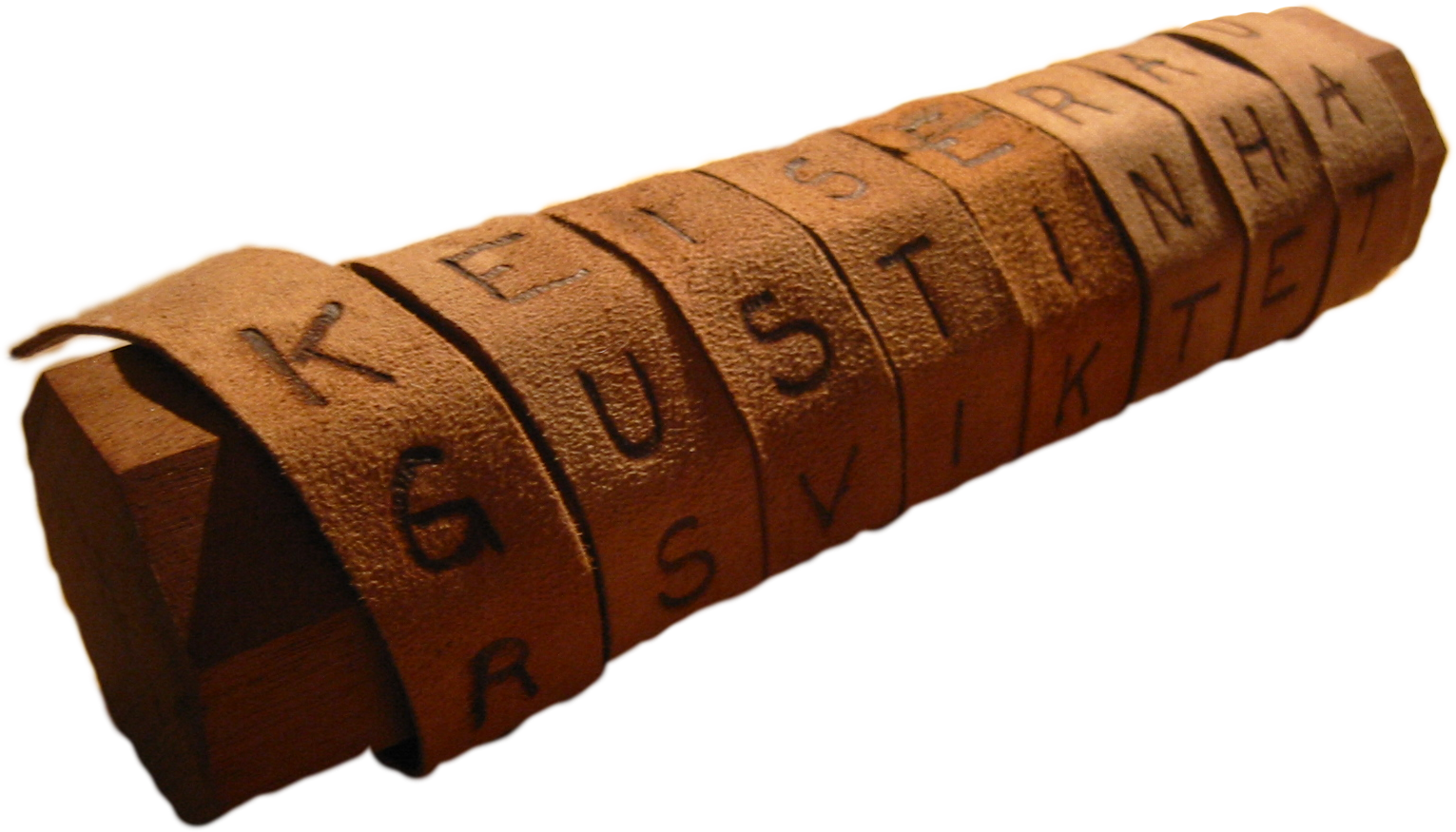
Scytale: A strip of paper is wrapped around a cylinder, and a message is written across the paper. Unwrap the paper and the message is meaningless, rewrap the paper around a cylinder of similar size and the message becomes clear. Old like the greeks.

Deciphering: If you write the message around something that is lying on the table (A pencil/marker, etc.) then simply handing them the strip of paper should be enough. If you want to give them several options, then the strip of paper should be handed out either before or after the cylinder is found and the cylinder should be disguised (Hairbrush handle) and with a variety of other objects.

Mirror Message: No, not just writing a message backwards. That's dumb and simple.

You can bisect the letters vertically and write a message using the letters: AHINOTUVWX
Or, you can bisect the letters horizontally and write a message using the letters: BCDEHIKOX
(Use a Scrabble Word Finder to get words)


Deciphering
: Once they figure out they need a mirror, they may use one nearby, if anyone bothered to purchase one. Alternately, you may hand out a mirror (or other reflective object) with several other items to obfuscate the text.

You can do this similarly with maps or secret codes using Catoptric Anamorphosis, but it requires some measure of artistic talent and a polished cylinder. On the other hand, if you have a reflective teapot, it can make a fascinating puzzle.

If I were going to attempt it, I would place the teapot/reflective mylar/tin foil wrapped around a paper tube, etc. on the paper, and sketch an outline in pencil of the map or message. I would have a good eraser.

Alternately it can be a letter substitution, or letters can
be missing from the cypher. 
Substitution Cypher: The message is in code. Substitution cyphers are simple to solve if you know the substitution. All the players have to do is have the message, either before or after they are shown a disguised copy of the cypher. It can be hidden in art, murals, colored, or otherwise disguised. The cypher could be written on pillars and stone tiles or hidden somewhere else in the environment.

Deciphering: The key factor here, is that the substitution key must be presented. You cannot fail to mention it, nor should you provide more emphasis on its discovery. If the message is handed out earlier or later then the discovery of the message then the connection must be made by the players. The key can be obfuscated (as in an element of a larger picture, message, or image), but should be available.

If you like posts like this, support me on Patreon!

On the Thursday Trick, Collapsing Walls

This post was originally published in January of 2015. If you're interested in Tricks and Traps like these, be sure to check out Artifices, Deceptions, and Dilemmas, collecting all of these along with beautiful illustrations. 

"In spite of the artificial setup of this room, collapsing walls don't show up often enough in published materials." -Brendan S.

I agree!

The room in question:
"At the top of the stairs are the remains of a door, beyond which is a room. The floor here is almost entirely gutted as is the floor below. 30' below is the gray stone of the cellar floor. There is an open door-way on the opposite side of the room on this level. Any exits from the first floor or the cellar have been completely filled with rubble. There are three possible ways to walk across the space—a charred and crumbling section of floor clings to the left wall, a narrow pathway of fallen beams stretches across the center like a bridge, and a sounder section of floor, only burned at the edge, runs along the right wall. All three paths are accessible from this end and lead to the doorway on the opposite side."
If the crumbling ledge is probed, large pieces of burned wood will crash to the floor. If any character steps on the ledge, it will collapse beneath them. The center path is narrow and will wobble slightly when stepped on. Plaster and ash will fall and the wood will creak and groan. As unsafe as it seems, the path is sturdy and may be crossed without falling. The ledge to the right is sound and solid. However, when the lead character reaches the halfway point, their weight will cause a loose beam underfoot to shift. The wall beside them will collapse inwards, knocking the figure off the ledge. If characters are roped together when this happens, each figure after the first must roll a successful bend bars/lift gates to stay on the ledge. Characters that fail will be pulled over the side. The fallen wall will block this ledge. A fall to the cellar will do 3-18 points of damage. (FOR TOURNAMENT USE: 12 points of damage). -A1:Slave Pits of the Undercity


Description: A wall is unstable or has been designed to collapse. A falling wall can expose the party to new hazards, such as basilisk, poisonous monsters or snakes, rushing water or lava, or anything better kept hidden. It can move party members or knock them over causing them to fall or separating them. The falling wall itself can do damage, or even release dangerous substances like asbestos, yellow mold, or acid. It can create new passageways and routes through an area for both the party and their allies.

Detection/Disarming: A collapsing wall is difficult to detect. As noted in the above boxed text, there is no special characteristic or description given to the wall, and indeed, it appears to be the most stable of the paths. The clue is given in the surrounding area. Collapsing walls may not be mortared or may even be described as walls of rubble. Walls designed to collapse may be plastered and smell or appear to be different. Depending on the type of collapsing wall, dwarves should automatically get their chance to detect this. Elves should also be able to use their sense of detecting secret doors to detect plastered or disguised walls.
Other indicators that the wall is unstable include:

  • Bulges or sagging walls, walls that are no longer completely vertical. ("The walls of this room bulge inward", "The convex walls of the chamber frame a. . . ")
  • A non-standard wall or a wall formed of a different substance. ("This chamber looks formed by rock collapse, the walls being piles of boulders stacked atop each other to the ceiling", or "The grey cemented bricks give way in this chamber to bricks surrounded by loose mortar")
  • Sounds or other descriptions could clue the players in ("The sound of rocks shifting as you enter this chamber gives way to dripping water. . ." or "There's a light static sound, as if sand were falling or settling")
  • There may be visible signs of wear on the walls. ("The stone walls in this room are cracked and worn with disrepair")

If you like posts like this, support me on Patreon!

On the Thursday Trick, Monster Guts

So, it never fails.

You put ONE GEM inside of a dead kobold, and for the next TWO YEARS your players butcher the guts of every creature they come across.

How to turn this into an example of agency instead of an automatic action?

Two steps:

  • Have a consequence for taking this action
  • Provide clues in the environment or the encounter that the creature might have eaten something

Consequence

Much of what a relevant consequence is has to do with what type of game your are playing. In a megadungeon, having the butchering take a turn and grant a bonus to the next one or two wandering monster checks is a reasonable and significant penalty.

In quest based small site adventures it becomes more difficult to institute a reasonable penalty. Perhaps a penalty to monster reaction, or in the likely event that reaction rolls are not used in your quest-based game, a penalty to social checks or even charisma for a short period after butchering the creature. Certainly in a more social game, providing to diplomacy, gather information, and bluff checks along with a bonus to intimidate checks) is a reasonable penalty (or a penalty on reaction rolls). 

Clues

What can clue you in that a person or animal might have something hidden inside their stomachs?

  • A wild animal lair with fresh kills of humanoids
  • A corpse nearby something subtly missing
  • A prisoner being interrogated
  • Nearby non-food substances having bite or teeth marks
  • Interesting items found in stools or obvious elimination areas 
These need not be obvious. A fresh kill in a monster lair can be described as having equipment, but with his guts and groin chewed out and eaten. Searching the stomach of the monster will turn up a belt buckle and pouch. The same with leaving a fresh kill that is missing a hand, where you find a ring inside the target.

The subtle missing item can be something very obvious i.e. "There is a circle of dust where something once stood on the table" or it can be more subtle "You find paper and pens inside a drawer" where the stomach contains magical inks. The corpse doesn't necessarily have to be in the room -- the players can kill it nearby and be forced to connect the missing item with the monster that could have eaten it. 

Interrogated prisoners will often consume anything valuable they are carrying to hide it.  

The other two are obvious clues that if downplayed only active and experienced adventures will follow up after itemizing the treasure they found.

Your support is needed. You like posts like this? Support on Patreon, and you keep them coming! Original publication date April 2014.


Hack & Slash 

FollowTwitchNewsletterSupportDonate to end Cancer (5 Star Rating)

On a Thursday Trick: Mirrors


This post was originally published in December of 2018. If you're interested in Tricks and Traps like these, be sure to check out Artifices, Deceptions, and Dilemmas, collecting all of these along with beautiful illustrations. 


Mirror Trick (Category: Special, Restraints/Hazards)

Description: Mirrors are a powerful tool, frequently overlooked and forgotten by dungeon designers. Consider mirrored walls, at a distance, strange figures that are difficult to make out. In a room with mirrors, distances can be confusing and surprising. It can be difficult to locate a target.
A mirror trap can be simulated by simply having each appropriate mirror face present another location for monsters the players can see.
Mirrors at the end of hallways confuse mappers, and frequently draw aggressive reactions. Hide something deadly behind a mirror and wait for a panicky player with a crossbow to unleash it on a party.
Magical mirrors are always useful. A covered mirror could be a mirror of life trapping. Mirrors that travel to other mirrors, or hide reverse of rooms or dungeons, or act as scrying devices all have a precedent in fantasy.
Mirror opponents, duplicates but in reverse created by the mirror are a classic opponent. How does the character beat himself? There's even an old transcription of a game in the 70's where a journalist comments on encountering a mirror that made a fighter fight his reflection.
"Mirrors" can representable portals to a similar dimension, requiring you to take some action in this world to cause an event to occur in the other—pull a lever, push a pressure plate, smash an obstacle.

Detection/Disarming: The important thing with maintaining agency about mirrors is making sure that you describe to the player exactly what they see and how it responds to them. You should work this out ahead of time (as above). Intelligent characters will ask questions and draw the correct conclusions. Reducing solving a puzzle like this to a roll should only be used for people unwilling to engage in exploratory play due to insecurity.
Only use these tricks to protect optional treasure or areas. Don't ever require a trick or puzzle as described as above as necessary to advance play.

Consider also, Tim Short's take on a mirror leading to a mirror universe, and this list of Mirror Effects from Aeons & Arguries.

Your support is needed. You like posts like this? Support on Patreon, and you keep them coming!


Hack & Slash 

FollowTwitchNewsletterSupportDonate to end Cancer (5 Star Rating)

On the Thursday Trick: Sand

This post was originally published in early 2019. If you're interested in Tricks and Traps like these, be sure to check out Artifices, Deceptions, and Dilemmas, collecting all of these along with beautiful illustrations. 

Sand 

Description: This is less "sand" or "quicksand" as a trap. Sand is often ill-considered during play, and yet. . .

Sand is more deadly than wild animals. Holes, unstable footings, and instability cause more deaths than wild animal attacks. From 1990 to 2016, there have been 16 deaths just from sand pits used for making sandcastles. Sharks only killed 12 people during that span. Source.

Culturally, if there is no lumber or tree industry nearby, non-industrial societies have 'sandmen' who Collect and 'clean' sand to bring into cities. It is used as a cleaning, degreasing, and abrasive agent. Once a lumber industry is running, sawdust is cheaper and more effective, causing this job to die off. But for non-industrial societies, collecting, moving, and cleaning sand is a necessary industry.

Green Sand
Sand describes a wide range of particles, from the large (64mm) to silt (.0004 mm). This consistency affects its behavior. You aren't going to sink into large grained sand. For example: Sand between .1 and .5 mm in diameter at the right humidity level will emit noises like whistling and barking. Video example 1, video example 2, video example 3.This can be up to over 100 decibels in volume. If you have a sand trap, where it pours in from somewhere, it could cause a terrible cacophony. If it happened elsewhere it could project the semblance of a terrible beast.

Sand near volcanic beaches can be straight up green. Olivine from the volcanic residue will produce a green color in the sand. Furthermore, sand can be beige or yellow. but also black, white, pink, red, gold, or purple, naturally.

Wizards who predict the future with sand would be called arenomancers. Arenolugry or Thaumoarenoists are sand wizards.

Areas with a lot of sand where it can be disturbed, (due to fights or fireballs) can put enough particularite matter in the air to cause illness, and if severe enough, cancer or death. Unprotected exposure to sand particles in the air can irritation of the eyes, nose, throat, and skin, or flu like symptoms like runny nose, lack of breath, a terrible cough.

This isn't particularly helpful, but did you know some desert animals (like sand cats) are just so damn efficient that they literally never drink? They get all the water they need from the bodies of their prey. Like all desert predators they are nocturnal.

Sand, of the correct type, will often be sought by glassmakers, wizards, and other people who need specific grades of sand for glassmaking.

For sand dominated areas, feel free to to remember that heat and water are scarce in deserts.

Quicksand

Quicksand is not limited to any specific climate or region. It can be found anywhere you find sand. A necessary component of quicksand is nearness to some body of water, whether underground or nearby.

What actually happens with quicksand is that it's super saturated with water. It's basically a deep pool, filled with a great deal of sand. The water volume is so high, that there's no friction, the pool is in a "colloidal" state and can't support any weight, any more than a swimming pool could, but the sand prevents you from swimming effectively.

You don't actually sink in very far. But the mistake most people make is that they try to push themselves out. Any attempt to "lift" out of the quicksand will cause another body part to push. This pushing disturbs the support and people sink further in.

Since the sand is more than twice as dense than the human body, you will not sink if you don't struggle. Falling head first into the sand can be deadly, being that you cannot remove your head, nor hold your breath long enough for your buoyancy to bring you to the surface.

Fantasy

Sail over the sand sea.
Giant worms snake through the sand.
Armies of the dead rest beneath the sands.
Burrowing predators harass characters in packs that swim through the sand.
Towers and whole cities rest buried beneath the dunes, the only entrance a single window at the top of a tower.
Balloons and parachutes allow sailing, held up by head coming off the dunes.
Mirages and illusions mess with dehydrated minds.
Wizards hide their towers among the dunes.
Sarlacc's and their cousins, giant dire antilions can be found among the sands.
Sandstorms ripe with magic bring thunder, lightning, and astral disruptions to the desert.
Sphinxes that live in the desert may take a dim view of you arriving to remove their valuable sand. Giant city like barges drift across the sands.
Silt striders, or other giant water bug like insects cross the sands, only their legs visible to players, their bodies far above the clouds.
In the wastes lie beasts like basilisks, sphinxes, and amphisbaena.
Victims of a sand necktie may be human or something else, often long dead, sometimes alive.
Creatures made from sand, or controlled sand shapes from sorcery nearby. (Video, nudity)


Detection/Disarming: Whenever using sand as an environmental variable, it's suggested that you explain to the players what's occurring and allow them to respond. Don't just immediately penalize them for sand exposure, mention that it's clouding the air and burning their lungs and eyes. If they don't take action to fix or correct the problem (Cloth over mouth, holding breath/closing eyes) then the penalties can apply.

The players need to be told about the hazard, before they get the chance to interact with it. Having quicksand or difficult terrain or pits on the battlefield, all should be described (if examined) before a player interacts with it.

Players should be told that sand is difficult terrain (double movement cost), but for sand that is actually hazardous (say full of pits), let people know that they will need to make a check to keep their footing. Quicksand is actually pretty difficult to spot, but allow players to take an action to try to identify which areas are unstable.

Your support is needed. You like posts like this? Support on Patreon, and you keep them coming!


Hack & Slash 

FollowTwitchNewsletterSupportDonate to end Cancer (5 Star Rating)

On the Thursday Trick, Vents, Sprays, and Agency

This post was originally published in September of 2011. If you're interested in Tricks and Traps like these, be sure to check out Artifices, Deceptions, and Dilemmas, collecting all of these along with beautiful illustrations. 

Vents & Sprays (Vents/Sprays)

Trigger: Varies Effects: Multiple Targets, Never Misses
Save:WandsDuration: Instant
Resets: AutomaticBypass: Avoid

Description: These traps are characterized by a variety of factors that separate them from spells or ranged attack traps. First, they often involved gasses or liquids and because they are often sprayed out over a large area they have the property of never missing.

In some cases there is also an onset delay. This means these traps can be triggered and the effect happen in a certain amount of time (sprinklers in a room) or a delay before the substance affects the characters (such as a room filling with water.

Examples of the things that might be vented or sprayed included slime, shrapnel, cold, acid, boiling water, flaming oil/tar, sewage, mummy dust, poison, fire, magma, smoke, methane, sand, steam, sulphur, and water.

If a to hit roll is required it will always ignore armor, but not necessarily shield bonuses. Saving throws may apply given the circumstance. Rods, Staves and Wands is the traditional saving throw for such attacks, allowing half damage or to avoid instant death.

Detection: These traps can be both the best kinds of traps, and the worst kinds of traps. Because they often have extremely negative properties, they can be ran in such a way where they are just Gotcha! traps, causing death or massive damage very quickly. However, this is an extremely poor way to run such traps, for several reasons. None of the vents and sprays above will be able to remove signs of their presence. Some examples
  • Slime will leave a slick slimy coating on the walls and floor
  • Shrapnel will leave gouges and scars in the walls and floor and ceilings
  • Cold vents and sprays may show some signs of their presence due to temperature differences,  areas where the cold strikes repeated may show cracking, the growth of natural molds and fungi may be retarded. If the trap is triggered often or recently, there may be frost, ice or water on surfaces. If it has been triggered somewhat recently, the water will affect the appearance of the walls (they will be cleaner).
  • Acid will leave pits and scarring on whatever surface it is sprayed on. There may be a scent, or the players eyes may start to become irritated.
  • Boiling water may show up due to temperature differences, and will generally insure a sparkling clean area where the walls and floor are blasted with it.
  • Flaming oil and tar will generally cover the upper walls and ceiling with black soot, and the floor may appear greasy or covered in scorch marks. Tar will stick to a surface and blacken and harden under high heat. The hallway may carry a scent of burning tar.
  • Sewage will smell overpoweringly terrible, unless it is stored behind water (like in a toilet) or behind an air tight valve or door.  There will still be an odor because it will be triggered occasionally filling an area with filth. There may be an unusually high amount of mold or spores or other type things in the area due to the rich food source the filth provides.
  • Mummy Dust may leave a coating of dust on surfaces, cause a musty spell, and their may be corpses in the hallway.
  • If a poison is being used in a spray, it most likely is fairly virulent, and therefore their should be corpses, either dessicated in a forgotten dungeon like a tomb, or bones or signs of being dragged off in a more active area.
  • If fire is being vented out, then on the surface that the fire is across from there will certainly be burn or scorch marks. Their may also be burnt corpses.
  • Magma if sprayed or vented out, will melt and re-solidify, causing whatever surface the magma contacts to deform. Areas where magma is sprayed will bubble, twist, buckle, and bulge from the constant melting and re-hardening. Bones and various other mineral items (armor and such) may be embedded in seeming solid surfaces.
  • Smoke will often linger for far longer then it takes to dissipate, leaving a smell for 60' to 100' from the location of the trap for days.
  • Methane is a very dangerous trap, relying on the players flaming light to trigger an explosion. There are several things to keep in mind with methane. First, it is odorless, the natural gas smell you are familiar with is a modern additive to help detect leaks. Second, it displaces oxygen, so even if the entire party has some means of seeing in the dark, it can rapidly cause asphyxiation. Use the rules for how long characters can hold their breaths unprepared for the length of time they can stay conscious.
  • Sand will both collect on the floor (and in clothes, armor, food, despite the best intentions). The first notice the adventurers will have will likely be the sound of sand crunching under their feet. Any surfaces subject to a spray of sand will likely be scrubbed clean. Repeated sand blastings will scour a surface clean, but will also remove the top layer, exposing rougher rock or metal beneath. Sometimes this will be used to fill a sealed chamber, in which case sand coated corpses will often be discovered.
  • Steam is going to insure that whatever surfaces the steam hits are clean, except for the bits of boiled flesh that it removes from it's targets. Do not forget to continue to apply damage as heat metal for people caught in steam wearing metal armor.
  • Sulfur is an interesting compound, either acidic causing burns, or a fine dust causing explosions, or a gas, causing choking and irritation. It is also known as brimstone. The primary method of detection is it's overpowering rotten eggs smell, which is natural.
  • Water is often not sprayed on people for damage, but more often is used to fill a sealed chamber trapping and drowning whoever is within. Water traps often leave water marks, as the fluid removes dirt and grime from surfaces and deposits it on a line along the wall. It also can have a briny or salty smell.
Do not forget that the vents and sprays also must come from somewhere. Nozzles, slots, slats or shutters will be visible places where the substances are expelled.

If you like posts like this, support me on Patreon!

On The Thursday Trick: Underground Hazards

This post was originally published in December of 2011. If you're interested in Tricks and Traps like these, be sure to check out Artifices, Deceptions, and Dilemmas, collecting all of these along with beautiful illustrations. 

Underground Hazards 

Description: The Sub-world is not like the world above!

Dungeons aren't supermarkets and there are dangers that exist only beneath the world. What features can be used to create interesting organic underground spaces?

Accidents and falling. This is interesting, because this hazard must be applied and telegraphed before used. Environments underground are not always smooth and level. This is naturally taken into account in every version of Dungeons and Dragons by the movement rate. It is bad form to punish your players beyond that for the underground and cramped movement space.

But that doesn't mean you can't use uneven ground. You just have to clearly communicate to the players where it is and under what conditions it applies. You can say "This ground is uneven enough that if you wanted to cross it at full speed, you have to make a dexterity check." You can inform the players of unstable ledges that could cause them to fall if they walk along them unless a check is succeeded. It's not that the basic level of these checks should be difficult, but that emergent events in the hazardous environment creates tension, tactical puzzles, and entertainment.

Note how I'm just assuming you would never present any sort of space without a vertical element, right? We're in the future of Star Trek II, where three-dimensional thinking rules.

Another thing that must be considered underground is light. Without a light source, movement becomes more hazardous. Stating that any movement out of bright light requires a balance or dexterity check can create an environment that feels hostile, held back by the characters light. This is extremely compelling, because it psychologically mirrors the activities during the game. They are exploring the literal unknown dark, and straying from their light is dangerous.

Again, not in every environment, and not by surprise. Variety is the spice of life.

Rockfall. Man, rocks fall from space under the open sky. You can sure bet they fall underground. Have a talk with your miners and dwarves about the stability of the underground areas. Some might be very stable. Some might cause rockfall due to the use of some sonic or thunder damage. Some might be so unstable simply passing through the room is dangerous. This should be another factor in underground environments that reward characters for playing dwarves or taking the appropriate skills.

Dehydration and Exhaustion. When Dungeons and Dragons was a more focused game about exploring dungeons, there were explicit rules to handle these.
RESTING: After moving for 5 turns, the party must rest for 1 turn. One turn in 6 (one each hour of the adventure) must be spent resting. If the characters do not rest, they have a penalty of -1 on all "to hit" and damage rolls until they do rest. 
Pretty straightforward. Adventures are heady stuff.

Flooding. It is a truth universally acknowledged, that a single cave, in possession of adventures and near a large body of water, must be in want of a flood. They know it's coming before it happens. Water dripping from the ceiling, deep roaring noises, slick walls covered in algae. Often the best way for flooding to work, is to have it be a triggable factor in the environment. You're underground. The cave is multi level. Popping the pimple of the water will change that environment, depending on the situation, to the monsters advantage or yours.

Becoming lost is too large a topic to cover here. Disease is also a serious hazard, but is its own topic.

Detection/Disarming: Falling and balance hazards just must be full stop presented to the players. They literally function as hazardous zones. By their nature and how humans deal with movement, we can easily tell the stability of an area and our capacity to cross it. (As you would well know if you ever walked through the woods and crossed a stream). The thing is, even if we don't know how dangerous it is, we can almost always tell that it is some degree of dangerous. Of course you can make an argument that there might be some hidden danger, but we are playing a game and designing an encounter. Putting in a "F&%k you, you're prone/take x damage" isn't fun, or particularly game like. It's not a choice, it's a tax.

Rockfall. Anyone with the appropriate skill or background should absolutely be able to tell what's going on mechanically here. If they ask. When presenting rooms with rockfall, make sure you note what's on the floor. Dust, small stones, loose rocks, a boulder, spiderweb divots and cracks in the ground. If it is a rock fall area, then rocks fall. Before entering any area where it's stable unless shatters or fireballs start going off, dwarves and characters should have a  handwaved check to determine if that is the case. It's more interesting for the game if the know the consequences of using loud, damaging, area of effect spells.

Flooding. Players are going to shrug their shoulders and move ahead when you give them clues that the cavern will flood. They will say, "Well, I've got to go on the adventure!" They will often feel that they have no control over when you will flood the cave. So it's important to present it clearly to the player so they understand the dynamic. Is it a dangerous area with the risk of instant death, not only from crushing damage, but needing a way to breath water? Will it wash the characters away? Will it destroy the temple? If you're using as part of a load-bearing boss, then it really doesn't matter, right? To make it interesting in the game, the players have to understand the threat, and you should be able to communicate it to them, so they can make meaningful decisions.


This post might be more useful than the entire Dungeoneers Survival Guide. If you liked it, and you'd like to see more monthly posts, please consider joining our hierarchy on Patreon for special Discord roles!


Hack & Slash 
FollowTwitchNewsletterSupportDonate to end Cancer (5 Star Rating)
On The Thursday Trick: The Kissing Maiden

This post was originally published in December of 2011. If you're interested in Tricks and Traps like these, be sure to check out Artifices, Deceptions, and Dilemmas, collecting all of these along with beautiful illustrations. 

In honor of the only trap in Skyrim to cause me to die. Twice.

Swinging Grate (Melee Attack)
Trigger: Pressure PlateEffects: None
Save: WandsDuration: Instant
Resets: AutomaticBypass: None (Avoid)
Disarm

Description: Often triggered by a pressure plate that releases tension, this trap swings forward impaling anyone standing in its way. This can be a single sharp post (al' la the original Conan movie), an entire wall, or even a statue of a beautiful woman. The trap often comes equipped with a counterweight for automatic rearming.

Detection: In the vast majority of cases this trap must be visible. It can be camouflaged or concealed, but the impaling mechanism can be seen. Common means of camouflaging the trap include vegetation growing on the mechanism, dim light, and angled walls and corners.

There are often blood spots on the floor and end point of the traps arc of execution. Even if successful, there will rarely be a body, due to its tendency to become impaled on the trap itself. If struck by a trap with a body already in it, damage might be mitigated. Bodies or skeletons hanging without supports on the wall might be another way to detect this trap.

More subtle means of detection include the hollow space where the counterweight resides. This will often be in either a wall or floor. The trap can be disarmed, but this almost universally results in the trap being triggered because it is under tension. Having a firm grip on the trap and releasing the tension slowly is one option, another is to not be where the trap is triggered.

If you like posts like this, support me on Patreon!

On Artifices & Deceptions: Triggers, Timed

Timed Triggers

This trigger just regularly springs the trap. Note that the trap may be set to use a timed trigger after the initial trigger is sprung.

Timed triggers are great obvious traps. This can be gouts of flame or swinging blades. They are buzzsaws, vines, and swinging logs. It is spinning pillars, anti-gravity platforms travelling up and down, and sections of floor that disappear or collapse after you step on them. They are rarely a danger themselves, but can make other situations more interesting. 

They are best used in situations where other objectives need to be met, rescuing hostages, defeating a bad guy, stealing an item, made all the more complicated by the regular changes in environment. 

Traditional use

S2 White Plume Mountain by Gary Gygax

7. The door opens onto a stone platform in a large natural cave. The ceiling averages 50´ above the level of the platform while the floor of the cave 50´ below is a deep pool of boiling mud. Points A and B mark the locations of geysers. Geyser A spouts once every five minutes. Geyser B spouts once every three minutes. Opposite the entrance platform is another stone platform, approximately 90´ away. Between them a series of wooden disks is suspended from the ceiling by massive steel changes. The disks are about four feet in diameter, and three feet apart. Each disk is attached to it’s chain by a giant staple fixed in its center. The disks swing freely and will tilt when weight is placed upon them. The disks and chains, as well as the walls of the cavern , are covered with a wet, slippery algal scum that lives on the water and nutrients spewed up from the geysers. This coating gives off a feeble phosphorescent glow.

When the geysers erupt, they reach nearly to the roof of the cavern, and creatures holding onto the disks or chains may be washed off to fall into the mud below (an almost instant death). Characters with 18 Strength, or better, have a 65% chance of holding onto a disk that is adjacent to an erupting geyser. For each point of strength less than 18, there is a 10% lesser chance of hanging onto the disks (i.e. 16 strength equals 45% chance.) However, for each disk the characters is located farther from the geyser, there is a cumulative chance 5% greater of holding on i.e. one farther away (from the adjacent disk) equals +5%, two away equals +10%, et. Damage varies as the distance from the geyser. Adjacent disk: 5-50 points; one away: 4-40, and so on: 3-30, 2-20, 1-10, 1-6 and 1-4 for anyone in the cavern. Characters who make their saving throw versus breath weapon will take only one-half damage.

Timed trigger design

Early timed triggers can be as simple as a swinging blade, something obviously and trivially avoided, at least until you get hit with a Fear effect or henchmen fail their morale rolls and run into it while fleeing.

Moderate timed triggers are an effective way to challenge mid-level parties with beginning challenges. Take an encounter for characters of 1st-3rd level and add gouts of fire that criss-cross the battlefield and it becomes an appropriate challenge for higher level characters. Another type of timed trigger is one where a normal activity is given a hard time limit, you must defeat the monster/pick the lock/disarm the trap before the room crushes you, the ceiling falls, the guards arrive, or your get cut apart my laser beams. 

If you like posts like this, support me on Patreon!

On Artifices & Deceptions: Triggers, Light

Light Detection: This trigger only functions in always lit or never lit areas. It works by using materials that react to the interruption or exposure to light. The source of light can be natural (sunlight/moonlight), magical (light, continual light), or man made (incandescent, torchlight, lasers). The trigger can be set to go off after the first interruption or detection of light, or it can be set to be triggered after a certain number of counted interruptions or time exposed to light.  This simplistic description of light detection neglects the various ways it can be used.

This is an effective trick or puzzle when the sensor responds only to a certain color of light.

The default stance of the trick, is of course that once torch, lantern, or sun-rod light is shone on the trigger, the trap is set, but it is also a useful stance for constructing a puzzle.

Often the sensor will be visible as a colored opaque crystal sphere. This should be breakable of course but doing so should ruin the mechanism.

The trigger most certainly does not have to be binary. It can require a certain degree or configuration of light, or perhaps be part of a multi-part puzzle where the light that triggers the light detector also gives a clue to the next step in the process while allowing the puzzle to succeed (like opening a door or portal where something must be thrown).

Traditional Use

S3 Expedition to the Barrier Peaks by Gary Gygax
2. STRANGLE VINES: . . .These creepers are attracted to the strongest light source, i.e. Continual Light, bright ship’s light, light, lantern, magic sword glow, torch light.
. . . If the ship’s lights are on the viewers will see various forms of large and small fish, and have a one in six chance of getting a glimpse of the “frog-thing”. . . Glints of gems will be seen from the lake bed! If they use lights in the observatory they absolutely will not only see that creature, but it will begin smashing at the plastiglass observation windows to get at the tender morsels within. The chance to break through is 5% per round. Attempts will cease as soon as the light is extinguished or the party is out of the monster’s sight.

S4 The Lost Caverns of Tsojcanth by Gary Gygax
1. SMALL CAVE WITH MANY TUNNELS
This low-domed chamber has its ceiling literally dripping with stalactites. . . A tribe of 18 troglodytes lairs in the five small tunnels which radiate from this cave. . . Unless the party is exceptionally quiet and shows no light, the trodlodytes will be lurking in ambush for them, and they will surprise the party on a 1-4 (d6) or a 1-2 if a ranger is leading the party.

T1-4 The Temple of Elemental Evil by Gary Gygax
339. HALL OF ELEMENTAL MAGIC
This huge echoing hall is constructed of polished black stones, which give back odd reflections of your light. The most striking features here are the symbols set into the chamber floor. To the north is a triangle of dull ecru stone, outlined with some sort of gray metal; a throbbing radiance seems to spread in dun-colored pulses that wash over the area. To the east is a great 10’ square of translucent stone, blue at the edges and shading to a deep green at the center, bordered by a strip of pale green; the whole gives out undulating sheets of blue-green light. To the south is a circle of translucent crystal ringed by a silvery band; the whole sends forth slowly rising clouds of pale light, that spread and disappear. To the west is a long diamond shape with four points radiating from the sides of the lozenge. The whole is fashioned of translucent stone mottled red and amber, outlined in red gold. It sends up sudden tongues of brightness, planes of pale fiery light that vanish as quickly as they appear.
All of these radiations gleam from the walls and floor of the hall. Any object in the center of the four symbols shows the four different illuminations, and the ghastly purple of their mix.. . . Any creature who steps into the area of an elemental symbol and stands there for 3 segments is transported to the corresponding Elemental Node: the Air Cavern (circle), the Earth Burrows (triangle), the Fire Pits (lozenge), or Water Maze (square). The only way to escape therefrom is to win through to another “gate” area or to possess the complete Orb of Golden Death, inset with all four proper gems.

Light detection design 
Early use can be situations in which characters must maneuver without light to avoid an enemy. Simple puzzles can differ based on the time of day or season. Mirrors to reflect light into certain spots (with multiple solutions so that players might discover one and not another). Later, more difficult puzzles can be avoiding light being used as a tripwire, or environments that change based on available light (such as a room that is different at night than during the day).

If you like posts like this, support me on Patreon!

On Artifices & Deceptions: Triggers, Proximity


This trigger is an extremely sensitive device that detects vibrations, most often transmitted through the air. They are generally sensitive and only used in out of the way places. Note that because they detect vibrations in the air, they are also extremely sensitive to sound. Non-thieves have a difficult time detecting these traps. There is little that you can do to notice this trigger, but the area around a proximity trap has no breeze, is very quiet, and often has either a thick layer of dust on the floor or no dust at all. Disarming it is a difficult and time consuming process - increase the length of time required to disarm a proximity trigger by 10 times. On the positive side, these triggers usually only trigger alarms or summon guardians of some sort.

Mechanical proximity triggers are interesting triggers because they often are not directly detectable. The only clues you will have to proximity detectors is that the area is sealed, and appears undisturbed. Even sensitive ones can avoid being triggered by someone who is quiet and walking softly, so approaching and disabling them is possible. The difficulty comes in finding them.

I would generally rule that finding a proximity trigger without triggering it takes twice as long as just searching a square normally. Also, that it can only be done by one person at a time, slowing down the process even more.

Since these are triggered by vibration, be aware of talking loudly or other action the party might take to set it off.

Another way to handle these triggers is to just set them off. Throw a thunderstone down the hallway and cover your ears.

The biggest clues you have in order to detect a trigger of this type are the signs that the area has not been disturbed or visited in a long time. Examples above, such as dust, are useful; other signs of proximity triggers in use include:
  • Cobwebs
  • Sagging shelves and furniture or curtains
  • Hard stone or metal hallway floors or acoustical ceilings to increase the noise made
  • The section of the dungeon is a sealed or is clearly a vault. 
For higher level characters, they may be facing powerful Wizards, Engineers, and Alchemists who may be able to make proximity sensors that only are triggered when player characters enter a certain (short) range. This method is used in the mid to high level modules below. This escalation can occur once they receive new tools for addressing problem solving (henchmen, constructs, Wizard Eye, Legend Lore, etc.)

Traditional use

C2: Ghost Tower of Inverness by Allen Hammack

6. BUGBEAR ROOM. . .

This 90'x90' room has a 20' high ceiling; there is a 10' wide passage in the center of the west wall. In the room are 16 bugbears without weapons, standing perfectly still; however, they do not appear to be statues. In the center of the north wall is a 10' long, 5' wide, 5' tall stone sarcophagus engraved with lettering.

The bugbears are in a type of temporal stasis; 4 will animate. . . and attack any intruders within the room each time one of the doorways is passed through. (For example, if a party member steps into the room and then out again, 8 bugbears will be animated.) The doorway, and not the floor, is the trigger: flying and levitation spells will still animate the monsters, characters using dimension door and teleport spells will not activate the bugbears, regardless of whether the room is entered or passed thereby.

T1-4: Temple of Elemental Evil by Gary Gygax

210. OCTAGONAL CHAMBER

If the bronze doors in area 145 (Dungeon Level One) are sundered, the stairs therein descend south to this room. However, entry is blocked by another set of like doors, set in the north wall of this area.

Illumination in this large octagonal room seems to come from everywhere — ceiling, walls, floor — a milky radiance which gives a dim and eerie glow to the whole scene. The floor of this place is 15' below the level of the normal dungeon floor, with short broad stairways leading to it. The ceiling vaults to a height of 40 feet. The walls and floor of the room are of polished gray stone with whorls of glittering mica; the floor is partially obscured by swirling, eddying, softly glowing mist. In the center of the area is a great pierced square of bronze, ten feet on a side. A dome is pierced in the northern ceiling, a circular shaft some 20 feet wide opening directly over a pit of the same diameter and five feet depth. Immediately to the south of the pit is a block of alabaster two feet wide, four feet high, and eight feet long. Atop it are two knives and a bowl of finest crystal. Ranking the pit are two crystal braziers, suspended from tripods by chains of silver. Each emits a faint sickly-sweet perfumed smoke. The doors to the north are bronze, sealed with iron, chained, barred, and bear a warning inscription in runes of some sort.

The altar stone and crystal service pieces are protected by a special glyph of warding suitable to the place. They cannot be safely touched unless the symbol of the Air Temple is worn and the glyph name, whah-duh, is spoken. Failure in either requirement causes a whirlwind to suddenly form and spin from the pit to the altar, inflicting 12 points of damage to each creature within ten feet of its path (save vs. spells to take half damage). This also triggers an alarm; the whole area gives off an evil-sounding chiming and tinkling, and the guardian is summoned

If you like posts like this, support me on Patreon!

Related Posts Plugin for WordPress, Blogger...